01 / OVERVIEW
Designing for More Inclusive Teams
This project explored the United Nations Sustainable Development Goal 5: Achieve gender equality and empower all women and girls. I focused on the experiences of women in STEM programs at Boise State University and how group dynamics can affect participation, confidence, and a sense of belonging.
Through interviews, systems mapping, and a visual "Draw It" research method, I explored how students experienced collaboration in predominantly male STEM environments. These conversations helped me narrow a broad social issue into a more actionable design opportunity: creating team environments where different voices, working styles, and contributions are more visible and supported.
The resulting concept was a team-building platform designed for the whole team. Rather than creating a tool specifically for women, I wanted to explore how better communication, self-awareness, and recognition could help everyone participate more effectively.
02 / RESEARCH & DISCOVERY
Understanding Women in STEM
I began by mapping the local STEM environment in Boise and identifying the people, cultural influences, systems, and accessibility factors surrounding women in STEM.
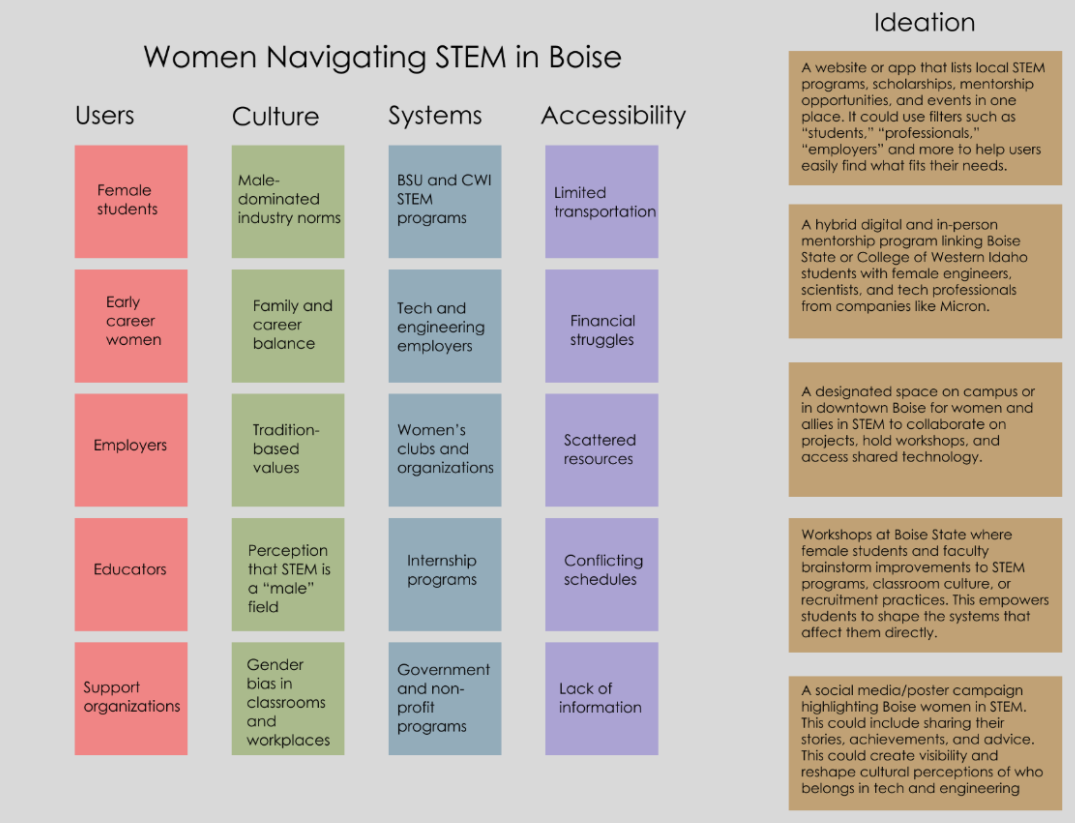
Systems map exploring the users, culture, systems, and accessibility considerations surrounding women in STEM.
Users
Female students, early-career women, employers, educators, and support organizations all occupy different positions within the STEM ecosystem.
Culture
Male-dominated industry norms, gender expectations, and perceptions around who belongs in STEM can influence students' experiences.
Systems
Universities, STEM programs, employers, clubs, internships, and support organizations all shape the opportunities available to students.
Accessibility
Transportation, financial limitations, conflicting schedules, scattered resources, and lack of information can make support harder to access.
03 / USER RESEARCH
Listening to Students
I conducted informal interviews with women in my academic community to understand how they experienced STEM environments, particularly within collaborative projects and classrooms.
PARTICIPANT INSIGHT
Being Heard
One participant described having to repeat herself to communicate her ideas and feeling that male classmates sometimes competed with her knowledge.
PARTICIPANT INSIGHT
Feeling Isolated
Another participant described frequently being one of the few women in her groups and feeling isolated when she did not see people who shared similar experiences.
PARTICIPANT INSIGHT
Representation
A third participant described noticing the underrepresentation of women in STEM from an early age and how those experiences shaped her expectations of the field.
04 / VISUAL RESEARCH
Making Group Dynamics Visible
I chose a visual "Draw It" method because I wanted to explore whether participants could communicate experiences visually that might be difficult to describe through conversation alone. I asked a STEM student to draw her ideal group dynamic alongside the group dynamics she typically experiences.
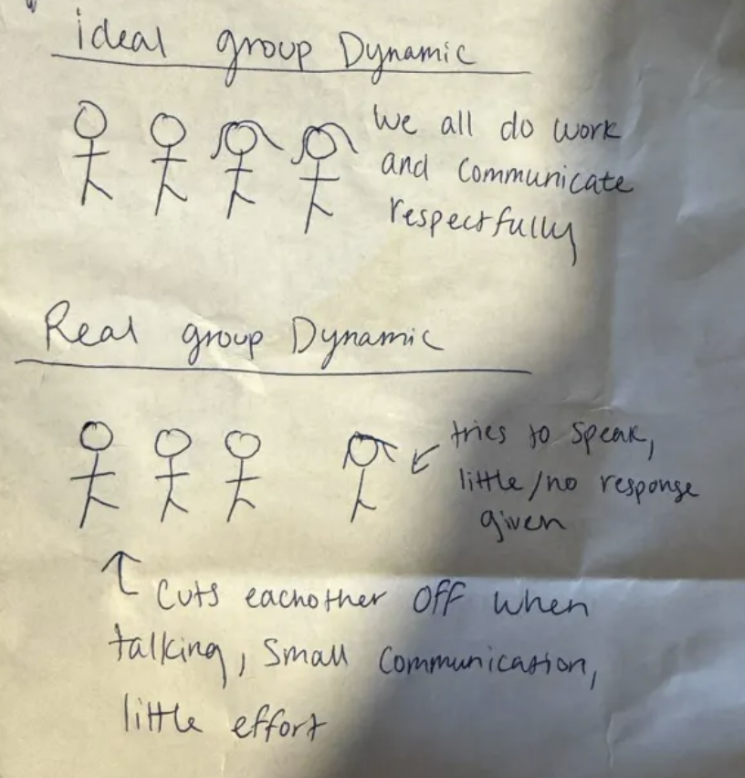
A participant's comparison of an ideal group dynamic and the group dynamics she typically experiences.
Ideal
Equal participation, respectful communication, shared effort, and teammates working together.
Observed
Interruptions, limited response to contributions, uneven communication, and a feeling of being separated from the rest of the group.
The exercise helped reveal that the challenge was not simply about technical ability. From the participant's perspective, the way teammates interacted with one another could affect whether she felt heard, valued, and included.
05 / FROM RESEARCH TO POV
Narrowing the Problem
My initial research covered a broad range of issues surrounding women in STEM. I used a Point of View exercise to turn those observations into more focused design opportunities.
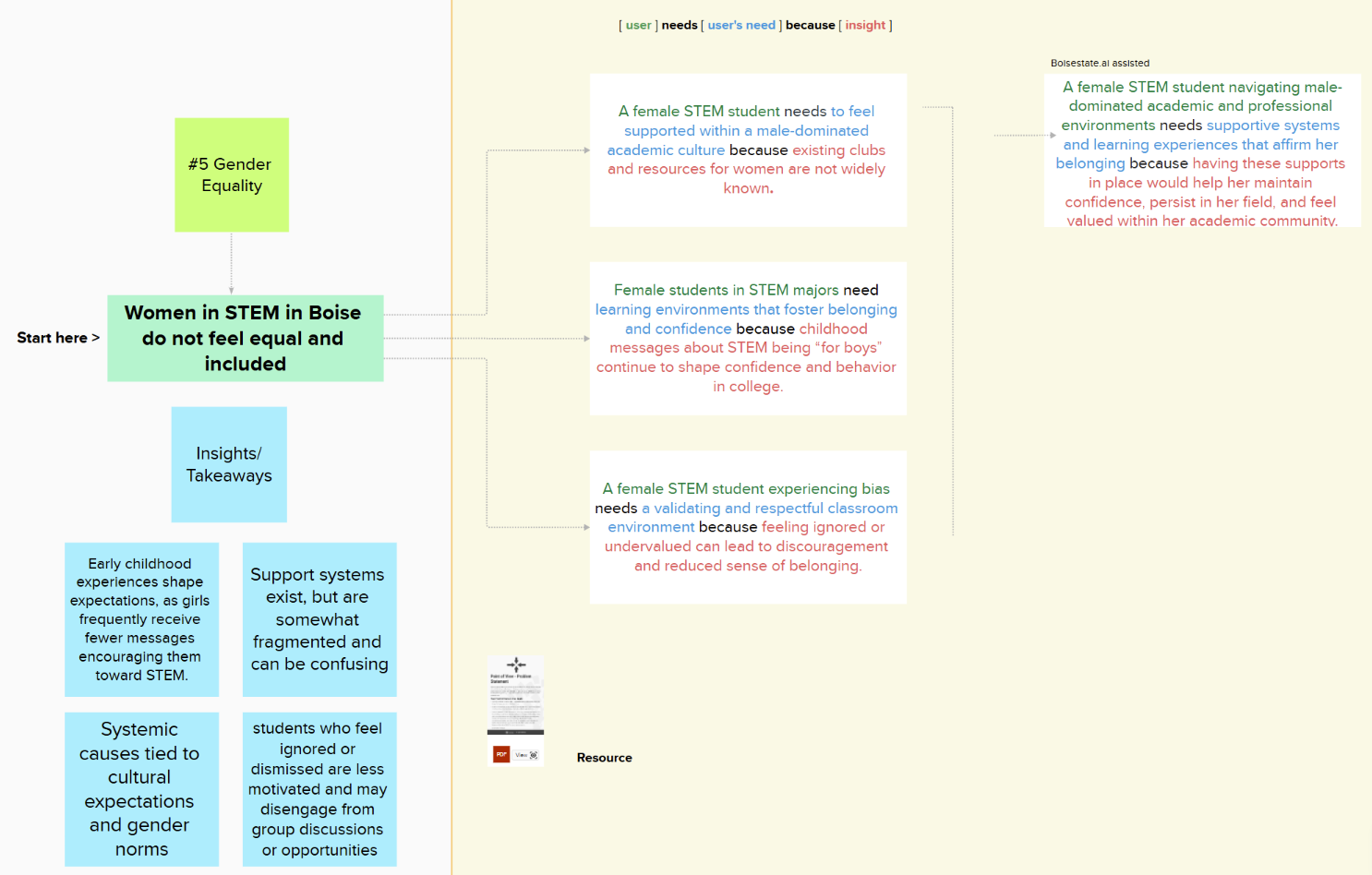
Point of View exploration connecting research insights to potential design opportunities.
SELECTED DIRECTION
Supporting More Inclusive Group Dynamics
I ultimately focused on the opportunity to create supportive team environments where students could better understand one another and participate more equally.
06 / HOW MIGHT WE
Exploring Possibilities
I generated multiple How Might We questions to explore different ways design could support positive interactions between students.
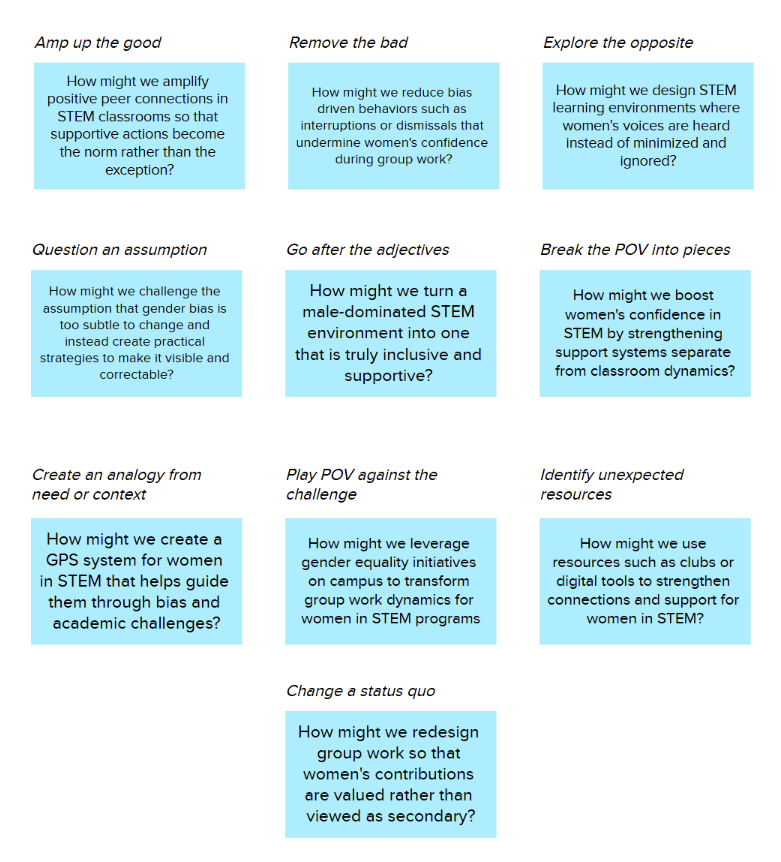
How Might We questions generated from the selected Point of View.
SELECTED QUESTION
How might we amplify positive peer connections in STEM classrooms so that supportive actions become the norm?
07 / IDEATION
Exploring the Solution Space
I explored several possible solutions, including peer acknowledgements, positive social interactions, digital bulletin boards, and connection cards that could help students understand one another's strengths and working styles.
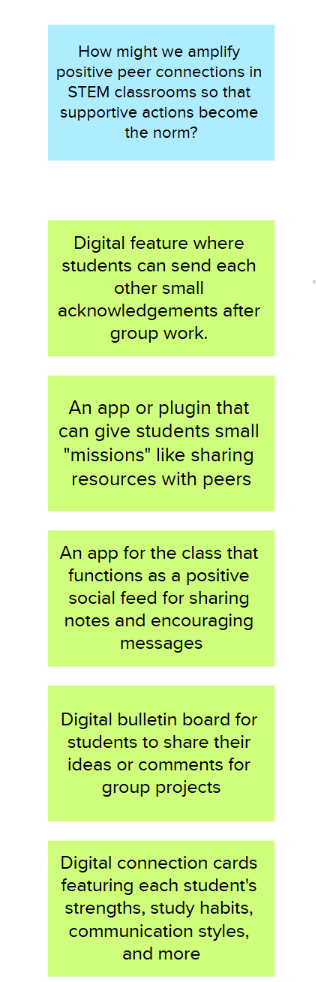
Early solution ideas generated from the selected How Might We question.
Peer Acknowledgement
Give teammates an intentional way to recognize helpful contributions and positive actions.
Digital Connection Cards
Give each student a profile describing their strengths, work style, communication preferences, and goals.
08 / LOW-FIDELITY PROTOTYPE
From Idea to Interface
I translated the connection-card concept into a web-based team platform. The early prototype focused on creating a personal profile, understanding teammates, assigning roles, sharing resources, and communicating within a project.
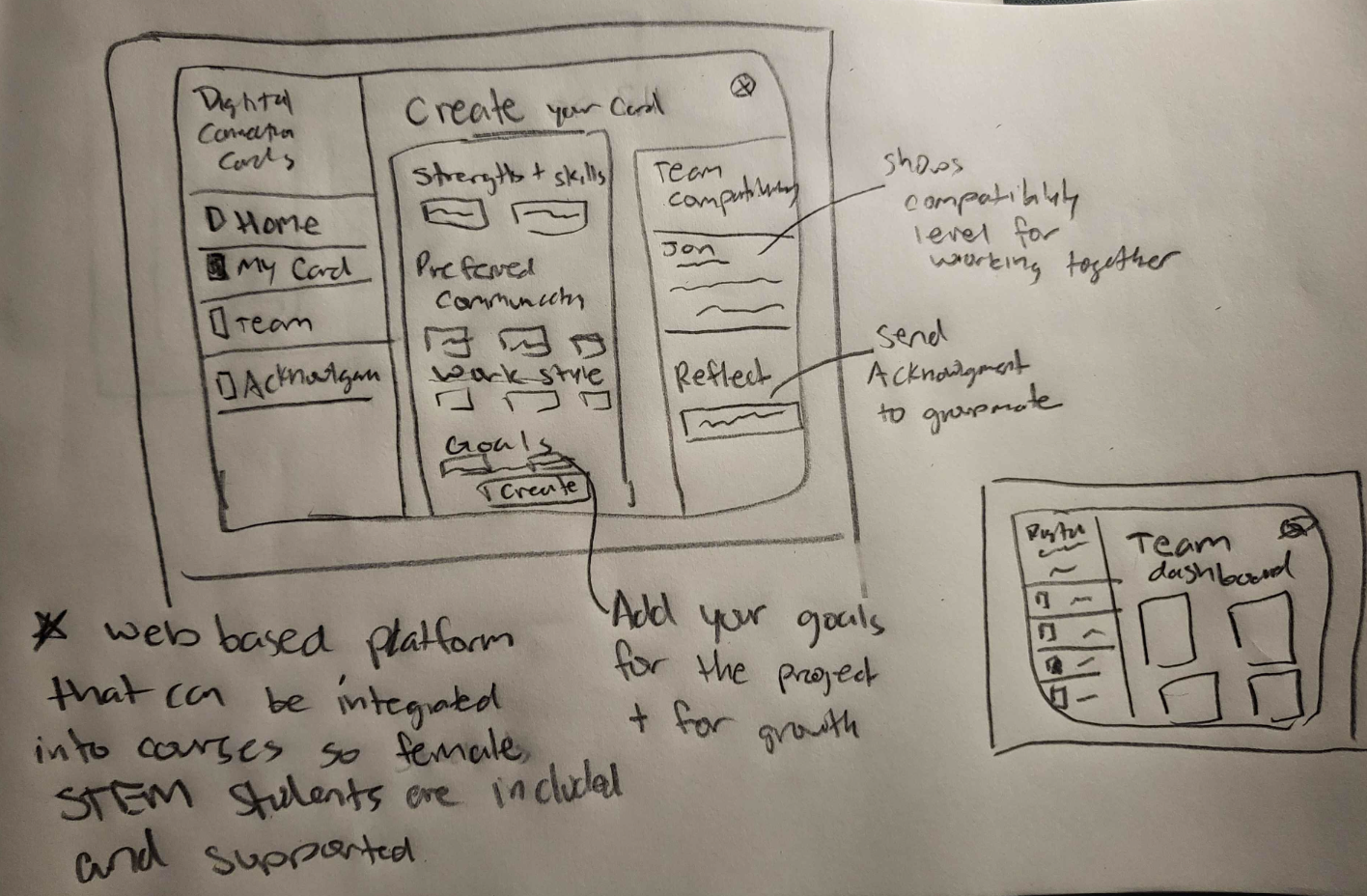
Early low-fidelity prototype exploring team profiles, compatibility, acknowledgements, and project tools.
09 / FINAL DESIGN
A Platform for the Whole Team
The final concept became a collaborative platform where each team member can communicate how they work best and learn more about the people they are working with.
Rather than designing a tool specifically for women, I designed the experience around a broader principle: teams work better when their members have opportunities to understand, communicate with, and recognize one another.
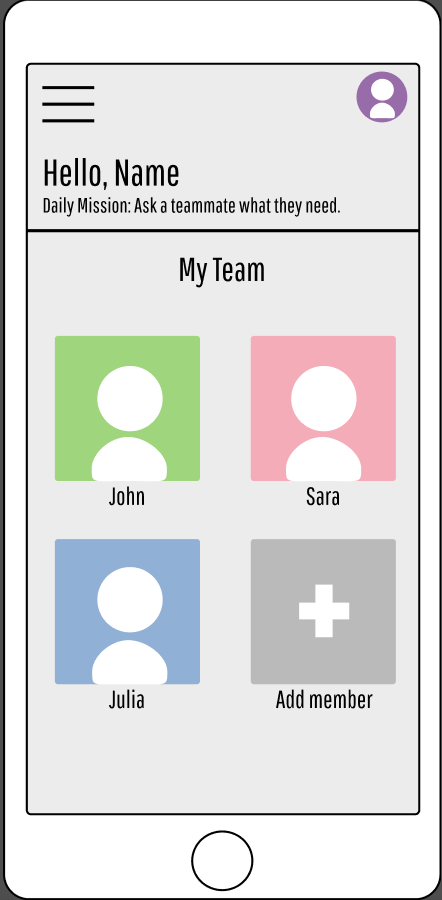
01 / HOME
Team Dashboard
The home screen gives users an overview of their team and provides direct access to the people and tools they need for the project.
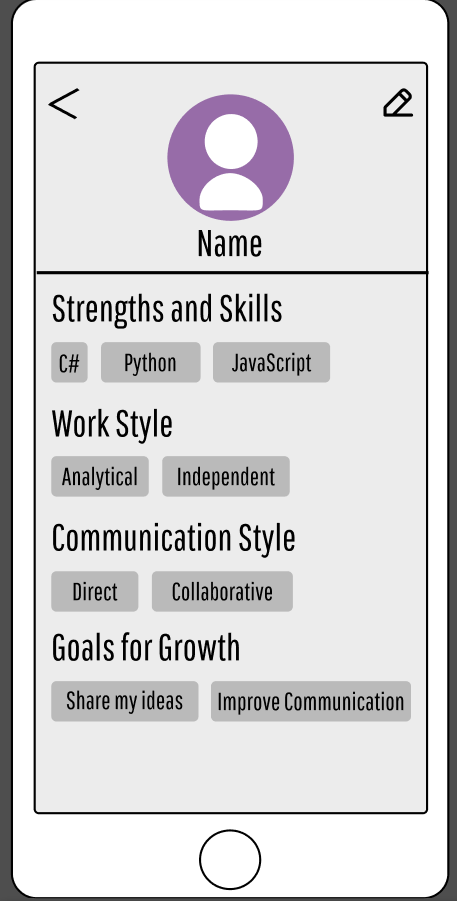
02 / PROFILE
Understanding How Teammates Work
Each person can create a profile highlighting their strengths and skills, preferred communication style, work style, and goals for growth.
The goal is to make information that is normally learned informally or through trial and error more visible to the team.
03 / TEAMMATES
Connecting Team Members
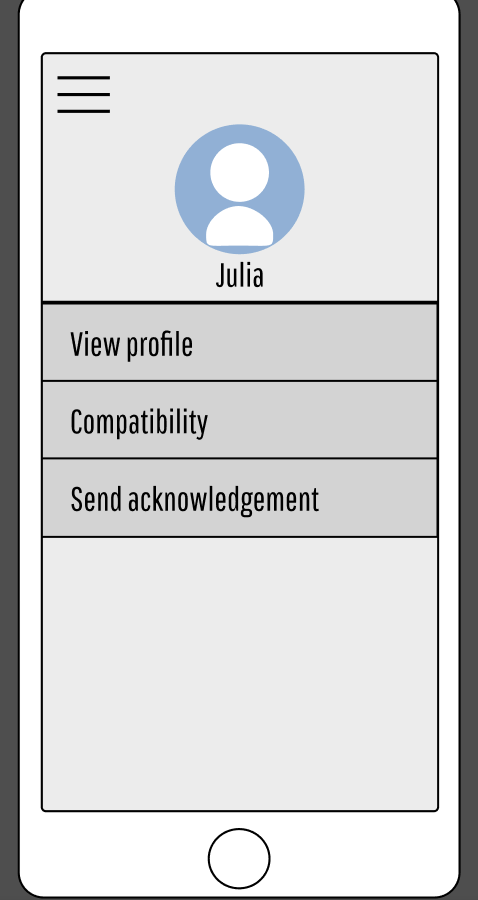
Users can explore teammate profiles, view compatibility information, and send acknowledgements directly from the teammate interface.
04 / ACKNOWLEDGEMENTS
Making Contributions Visible
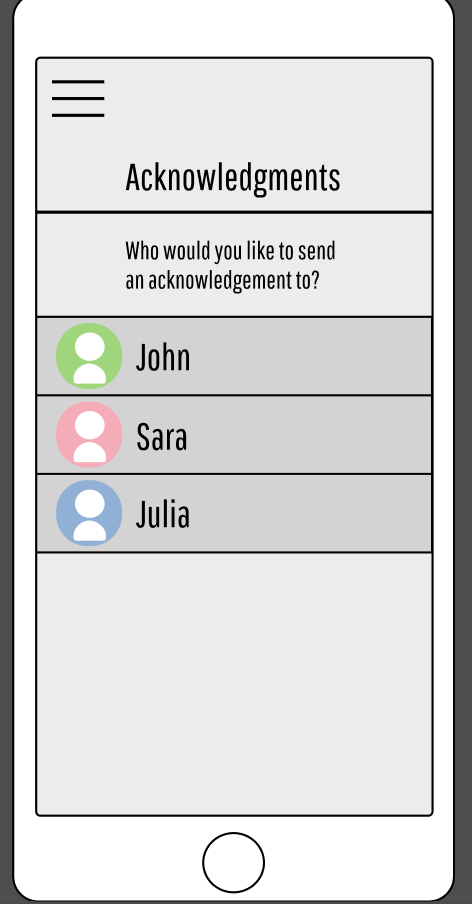
The acknowledgement feature gives teammates a simple way to recognize one another's contributions.
This directly responds to the research around feeling unheard or overlooked by creating an intentional space for positive recognition.
05 / RESOURCES
Supporting the Work
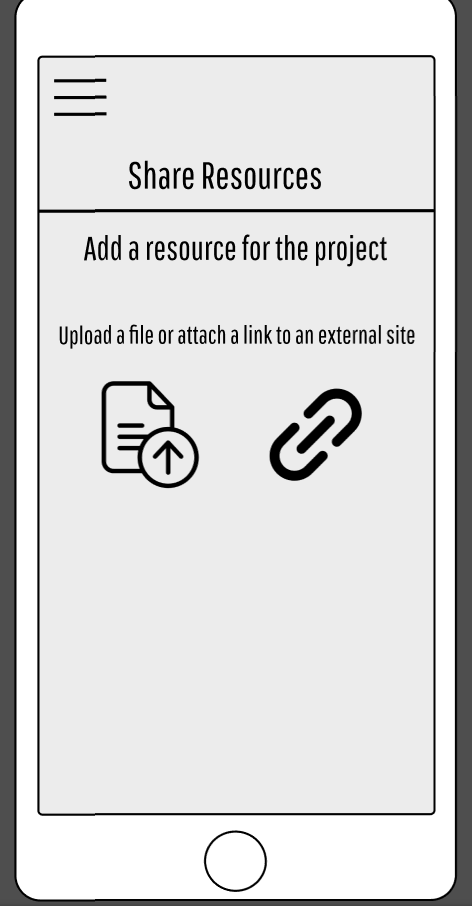
Teams can share project resources, files, and external links in one shared space rather than relying entirely on separate communication channels.
06 / PROJECT CHAT
Encouraging Participation
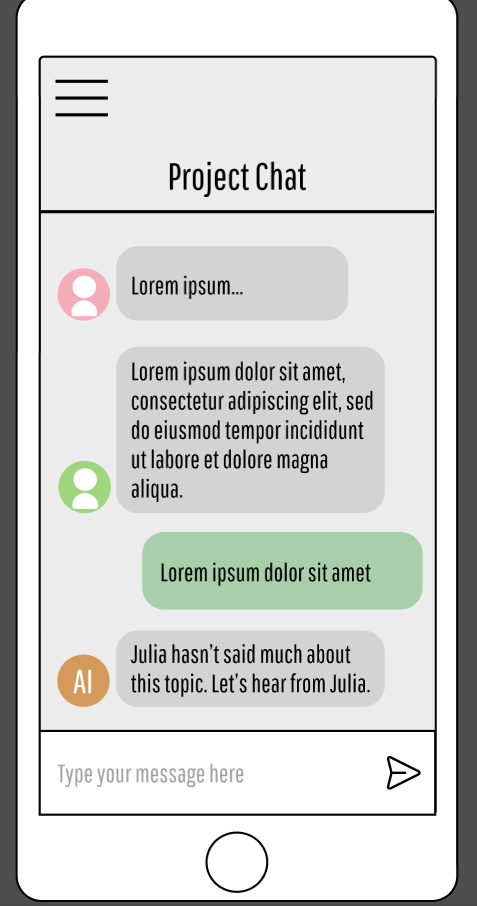
The project chat gives teammates a shared space for communication. An AI-assisted prompt can occasionally encourage quieter team members to contribute to the conversation.
The goal is not to replace human communication, but to provide an additional nudge toward more balanced participation.
10 / KEY DESIGN DECISIONS
Designing for Inclusive Collaboration
Make Differences Visible
Profiles help teammates understand different strengths, communication preferences, and working styles before problems arise.
Encourage Recognition
Acknowledgements create a simple mechanism for teammates to recognize helpful contributions.
Support Every Team Member
The experience is designed for the entire team, rather than positioning inclusion as something only certain team members need.
11 / PROTOTYPE
Prototype Walkthrough
Explore the interactive prototype to see how the team-building experience connects profiles, team interactions, resources, acknowledgements, and project communication.
COMING SOON
Interactive Prototype Walkthrough
A short walkthrough demonstrating the final interactive Figma prototype will be added here.
12 / REFLECTION
From a Broad Social Problem to an Actionable Design
This project taught me how important it is to narrow a complex social issue into a specific and actionable design opportunity. I began by exploring gender inequality in STEM broadly, but conversations with students helped me focus more closely on participation, communication, and belonging within collaborative environments.
The project also reinforced the importance of designing for differences rather than assuming every person communicates or works in the same way. Instead of asking one group to adapt to another, the final concept explores how a shared system can make individual preferences and contributions more visible to everyone.
While this prototype represents only one possible intervention, the process helped me understand how qualitative research can reveal opportunities for design that are difficult to see from the outside.